PROMIS_2023 project
LEDtech-GROW
In light of global urbanization, the key to long-term agricultural development is a more efficient use of arable land, labor, and modern technology. Indoor plant factories are promising solutions for future horticulture production and food supply to densely populated urban areas. The light-emitting-diode (LED) is revolutionizing general illumination with the promise of enormous energy savings when widespread adoption occurs. However, current LED technologies for plant cultivation are less developed compared to LEDs for general lighting. LEDtech-GROW offers innovation in the field of LEDs that entirely satisfy the needs of plants and cannot be achieved with any LED technology currently available. To maximize such benefits, we will address a few critical issues: light quality, long-term stability, and the environmental impacts of the chosen solutions. We will develop inorganic phosphors that convert as much electrical energy as possible into a Photosynthetically Active Radiation (PAR) spectrum of plant photoreceptors, which differs from one required for general lighting. This groundbreaking technology will deliver double and triple-wavelength emitting phosphors that increase light output for cryptochrome and phytochrome photoreceptors while ensuring high color quality. The fundamental concept of inner-particle energy transfer between Bi3+ and Eu3+ ions significantly contributes to the development of plant-grow-targeted LEDs. Therefore, we will design and fabricate highly efficient, environment-friendly, and moisture-resistant plant-grow-targeted LEDs based on bismuth-sensitized Eu3+-activated single-component phosphors for the whole PAR spectrum.
Overall objective
Our mission is to develop sustainable and environment-friendly LED technology for cost-effective indoor plant growth. Requirements for plant-grow-targeted LEDs differ from those for general lighting since their emission should provide an efficient electric energy conversion to the PAR spectrum of plant photoreceptors rather than match the spectral sensitivity of the eye. Also, moisture-resistant plant-grow-targeted LEDs are urgently needed due to the high-humidity environment in which they operate. These plant-grow-targeted LEDs will offer several benefits, including increased yields, earlier flowering, faster root growth/germination, better control of plant growth, and more economical use of arable land. Therefore, the science-to-technology innovation is new LED technology that entirely satisfies the needs of plants and cannot be achieved with any LED technology currently available.
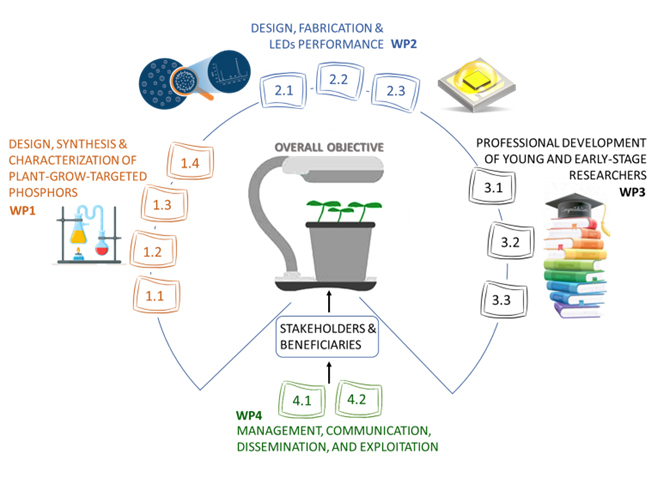
WORK PACKAGES
Design, synthesis, and characterization of plant-grow-targeted phosphors
Synthesis and characterization of highly efficient and moisture-resistant plant-grow-targeted phosphors based on double- and triple-wavelength emission in single-component host matrices for the whole PAR spectrum (providing feedback to WP2).
- Synthesis and design of traditional Eu3+- and Bi3+/Eu3+-activated inorganic fluoride phosphors;
- Synthesis and design of a novel generation of Eu3+- and Bi3+/Eu3+-activated inorganic fluoride phosphors;
- Structural, morphological, and optical analysis of phosphors;
- Temperature-dependent photoluminescence, quantum efficiency, and chemical stability of phosphor.
Design, fabrication, and LEDs performance
Synthesis and characterization of highly efficient and moisture-resistant plant-grow-targeted phosphors based on double- and triple-wavelength emission in single-component host matrices for the whole PAR spectrum (providing feedback to WP2).
- Synthesis and design of traditional Eu3+- and Bi3+/Eu3+-activated inorganic fluoride phosphors;
- Synthesis and design of a novel generation of Eu3+- and Bi3+/Eu3+-activated inorganic fluoride phosphors;
- Structural, morphological, and optical analysis of phosphors;
- Temperature-dependent photoluminescence, quantum efficiency, and chemical stability of phosphor.
Professional development of young and early-stage researchers
Objective: Young and early-stage researchers gain confidence and motivation to apply for EU programs and funding, as well as expertise and know-how for successful project implementation.
Management, communication, dissemination, and exploitation
Coming soon